The Benefits of Meeting Analysis: Turning Conversations into Real Performance
Summary
1- Introduction
2-Why Meeting Analysis Matters
3- From Meeting Analysis to Organizational Insight
4- How Elokencia Takes Meeting Analysis Further
5- The Strategic Value of Meeting Analysis
Meetings play a central role in modern organizations. They are where decisions are made, priorities are set, and alignment is supposed to happen. Yet despite the time invested, many meetings fail to deliver clear outcomes or measurable impact.
This is where meeting analysis becomes essential. By systematically analyzing how meetings are planned, run, and followed up, organizations can transform meetings from a cost into a lever for performance.
1. Why Meeting Analysis Matters
Research consistently shows that meetings consume a significant share of working time and are often inefficient. Harvard Business Review reports that senior leaders spend nearly half of their working week in meetings, many of which they describe as poorly structured or unproductive (Harvard Business Review). McKinsey similarly found that 61% of executives believe much of the time spent in decision‑making meetings is ineffective (McKinsey).
Without analysis, meetings are managed based on habit and intuition. With analysis, they become measurable processes that can be improved over time.
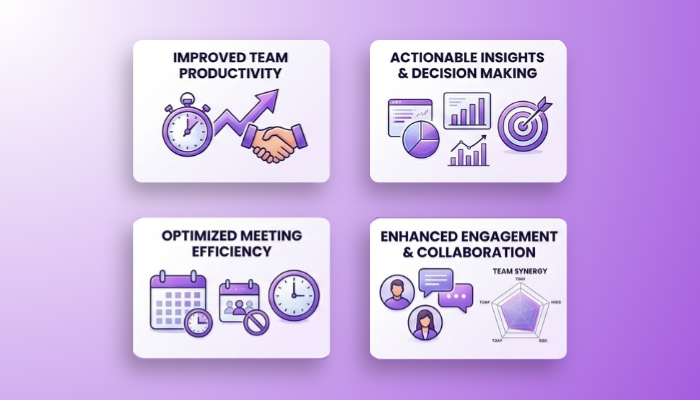
Key benefits of meeting analysis include:
-
Improved decision‑making
Analyzing meetings helps organizations identify whether discussions actually lead to decisions. Clear visibility into decision points, delays, and repetitions allows leaders to improve how decisions are framed and finalized. McKinsey highlights that better‑designed meetings lead directly to faster, higher‑quality decisions. -
Better use of time
Meeting analysis reveals where time is lost: meetings without agendas, unnecessary participants, or recurring topics with no resolution. Data from Flowtrace shows that 60% of one‑off meetings lack a structured agenda, a major driver of inefficiency (Flowtrace). -
Higher engagement and participation
When participation patterns are analyzed, organizations can detect imbalance, where a few voices dominate and others disengage. This insight helps teams redesign meetings to be more inclusive and effective. -
Stronger accountability and follow‑through
Analysis also looks beyond the meeting itself. Tracking whether action items are assigned and completed transforms meetings into engines of execution instead of isolated conversations.
2. From Meeting Analysis to Organizational Insight
Modern meeting analysis goes further than simple metrics like duration or attendance. Evidence‑based research from the Chartered Institute of Personnel and Development (CIPD) shows that productive meetings are driven by clarity of purpose, structured follow‑up, and ongoing learning over time (CIPD).
This shift reflects a broader reality: meetings are one of the richest sources of data about how an organization actually works. They reveal how people communicate, collaborate, handle conflict, and make decisions.
3. How Elokencia Takes Meeting Analysis Further
While many organizations recognize the value of meeting analysis, few have the tools to apply it at scale. This is where Elokencia stands apart.
Elokencia is an AI‑powered meeting intelligence platform designed to transform meeting analysis into a practical, continuous process that drives execution and team growth.
3.1. Beyond Simple Meeting Metrics
Most tools stop at transcripts or summaries. Elokencia analyzes meetings across multiple dimensions, including:
-
Productivity and time management
-
Engagement and proactivity
-
Behavioral dynamics
-
Emotional signals
This allows leaders to understand not just what happened in a meeting, but how and why it happened.
3.2. Turning Analysis into Action
Elokencia automatically extracts:
-
Decisions
-
Tasks and responsibilities
-
Clear follow‑ups
By connecting these elements to future meetings, Elokencia ensures continuity and accountability. Meetings no longer exist as isolated events but as linked steps in an execution flow.
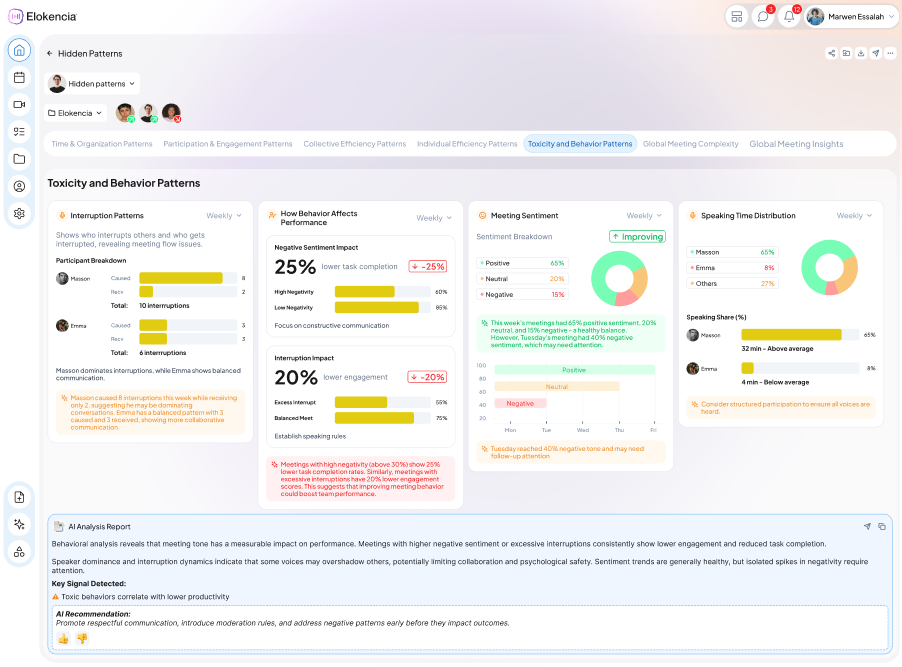
3.3. Revealing Hidden Patterns Over Time
One of Elokencia’s most powerful capabilities is its Hidden Patterns engine. By analyzing multiple meetings over time, the platform identifies:
-
Recurring blockers
-
Behavioral patterns that slow teams down
-
Signals of tension or disengagement
-
Collective efficiency trends across teams
This transforms meeting data into organizational intelligence, giving CEOs and managers visibility that traditional feedback systems rarely provide.
3.4. Enabling Data‑Driven Coaching
Instead of relying on subjective impressions, Elokencia supports data‑driven coaching. Managers can help individuals and teams improve communication, collaboration, and decision‑making based on real meeting behavior.
This approach aligns with research showing that continuous feedback grounded in observable data leads to more sustainable performance improvement.
4. The Strategic Value of Meeting Analysis
In a world where time is one of the scarcest resources, meetings represent a major investment. Meeting analysis ensures that this investment delivers returns.
By applying structured, AI‑powered analysis through platforms like Elokencia, organizations can:
-
Reduce wasted meeting time
-
Improve decision quality
-
Strengthen accountability
-
Build healthier, more effective teams
Meeting analysis is no longer optional. It is a strategic capability and with Elokencia, it becomes a practical reality.